Designing explainable AI for gold loan audits
GOLD LOAN EVALUATION AGENT · ROOTFLO · PILOT

Role
Product designer
Timeline
2 months
Team
2 founders, 6 engineers, 1 product designer (Me)
Responsibilities
UX Research, Product Design, UI Design, Prototyping, Vibe Coding
Overview
How do you make AI trustworthy enough for high-stakes financial decisions?
Gold loan evaluation is still heavily dependent on manual appraisal. A small error in estimating gold purity, stone weight, or suspicious jewellery can directly affect how much a bank lends. Rootflo was exploring how AI could automate parts of this process - and I led the end-to-end UX for an AI-powered Gold Loan Evaluation Agent that helps banks identify risk, review flagged loans, and make more defensible decisions.
User Research
Understanding how branch agents and auditors evaluate gold loans today, and where manual processes introduce risk.
Product Design
Designing an audit experience that surfaces the right signals without overwhelming auditors with AI-generated information.
Prototype
Rapidly prototyping the experience and testing the workflow with stakeholders from a banking environment.
problem
Manual gold loan evaluation is slow - and expensive when it goes wrong.
Gold loans are high-volume financial products. Branch staff manually evaluate jewellery using traditional methods such as touchstone testing. A single incorrect appraisal can lead to excessive disbursement or delayed fraud detection.
Estimated appraisal error rate.
Stone-weight deviations
Incorrect stone-weight deductions can increase the effective LTV of a loan.
No risk prioritization
Auditors review large volumes of loans without a structured way to identify which cases need attention first.
Spurious gold
Fraudulent or suspicious jewellery can be difficult to identify during manual appraisal.
Weak audit trails
Decisions need to be traceable and defensible, especially for compliance teams.
Opportunity
What if AI could tell auditors where to look first?
Instead of replacing the auditor, the AI agent could act as a second layer of supervision. It could analyse jewellery images, identify anomalies, and surface high-risk loans - while keeping the final decision with the human.
Prioritize risk
Help auditors focus on the loans most likely to require investigation.
Surface evidence
Turn image analysis into understandable signals rather than an opaque AI score.
Standardize evaluation
Reduce variation between manual appraisals.
Preserve human control
Give auditors the ability to review, challenge, and override AI recommendations.
Solution
An AI supervisor for high-risk gold loan decisions.
The Gold Loan Evaluation Agent analyses loan packets and surfaces potential risks for auditors. The experience is centred around a Loan Deep Dive - a workspace where auditors can understand what the AI found, why it matters, and what action to take. The system evaluates:
The goal was simple: Help auditors make faster, more accurate decisions without losing control.
Core flow
From thousands of loans to one decision.
The experience follows a simple progression:
Find
A structured loan dashboard gives auditors a searchable view of their cases.
Prioritize
Filters and risk indicators help surface suspicious or high-risk applications.
Investigate
Loan deep dive brings together AI analysis, jewellery details, stone-weight data, & alerts.
Decide
The auditor reviews the evidence and makes the final decision.
Research
Understanding how auditors actually review loans.
The first version of the product surfaced a lot of information - but that didn't necessarily mean users could find what mattered. During pilot testing with banking stakeholders, I observed how users navigated the Loan Deep Dive.
Users rarely scrolled.
Auditors tended to stop around the jewellery table, meaning important risk information further down the page was being missed.
Filters created another problem.
Once auditors filtered the loan list, they still had to open each loan individually to review it.
Risk wasn't visible early enough.
The interface made users inspect the evidence before understanding the overall risk.
insights
Risk needs to be visible before the details.
Auditors were stopping before reaching critical information further down the page.
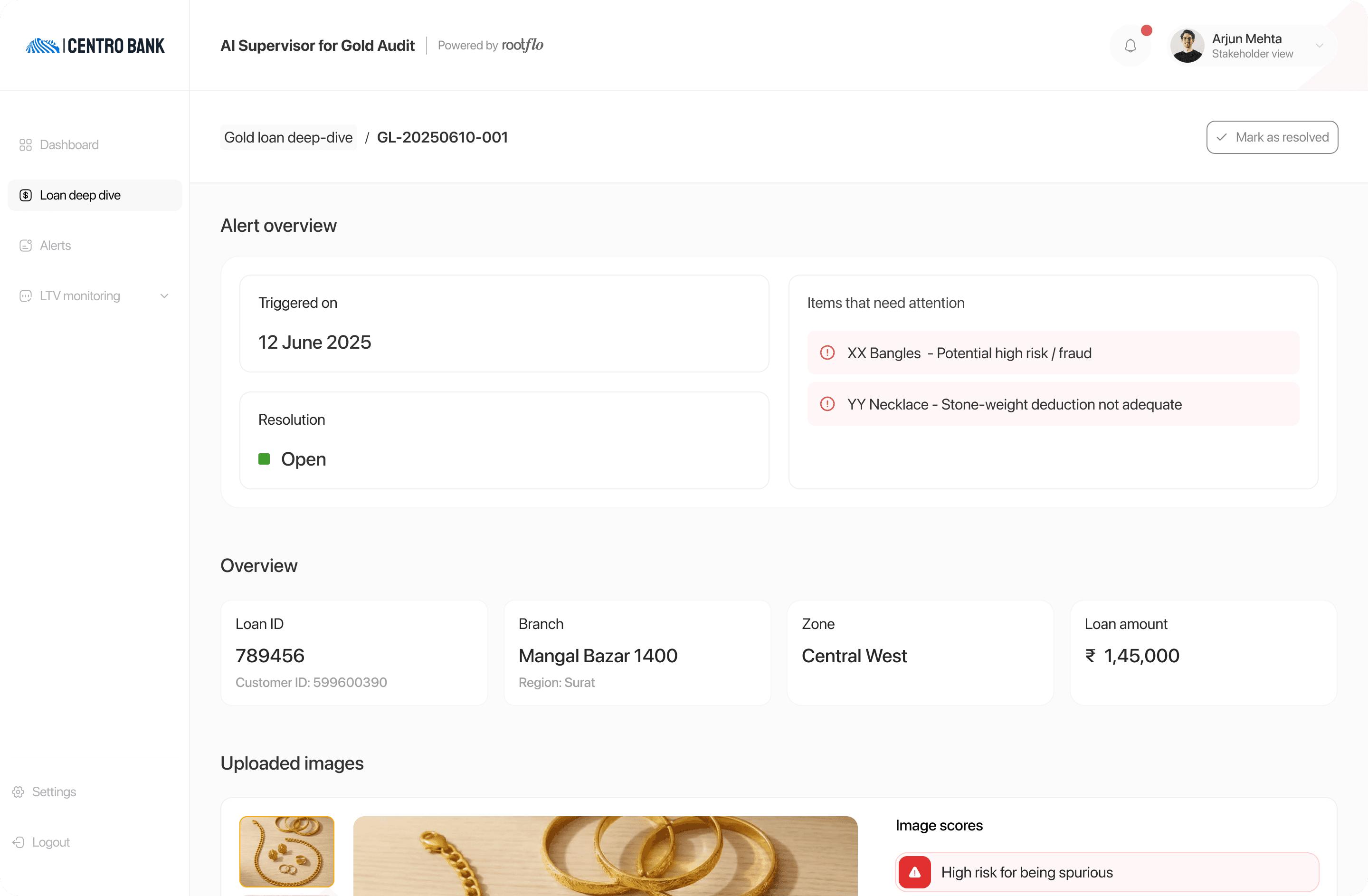
Before
The page started with detailed jewellery information, pushing the final assessment below the fold.
After
I moved the final verdict to the beginning of the experience, giving auditors an immediate understanding of the loan's risk before diving into the evidence.
Verdict → Evidence → Details
Related information should live together.
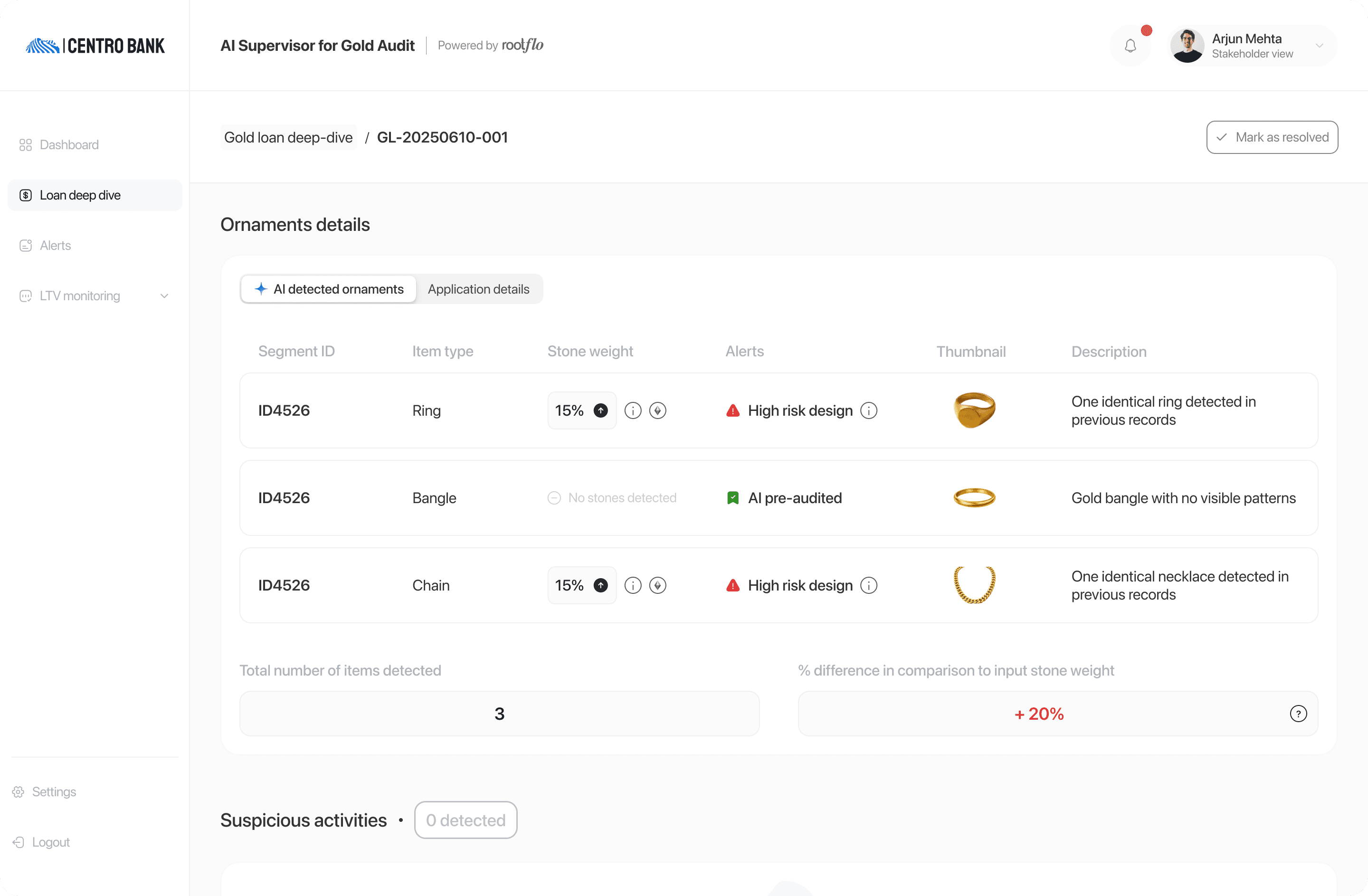
Stone-weight deviations were responsible for approximately 50% of inspector flags. The existing experience separated the branch-entered value from the AI estimate, making comparison harder.
solution
I introduced a side-by-side comparison of:
Branch-entered stone % vs. AI-estimated stone %
Deviations above 10% are highlighted. Auditors can still override the AI assessment, but the override requires a justification.
Don't block the human. Give them better evidence.
live product
Reviewing filtered loans shouldn't mean opening them one by one.
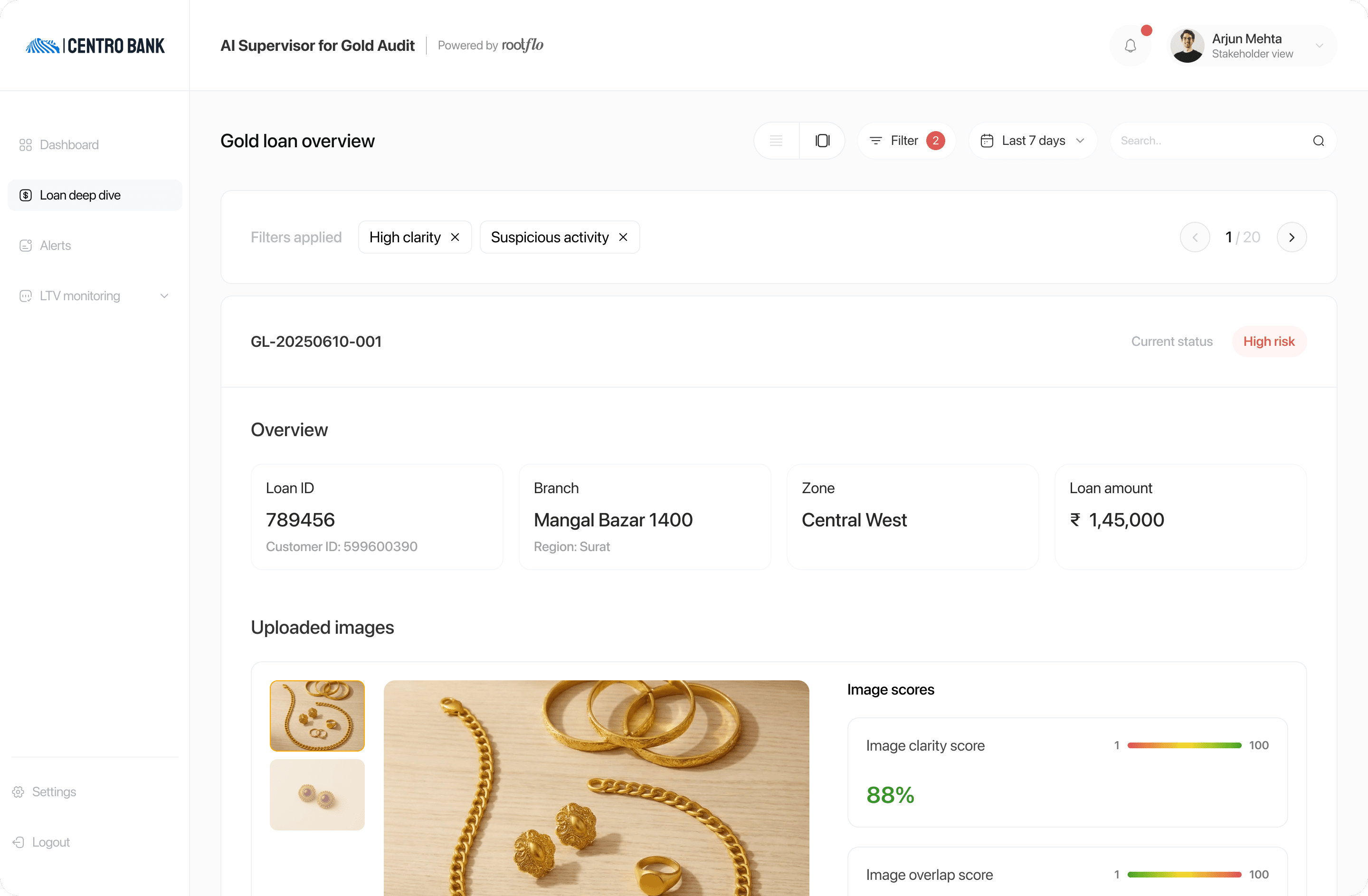
Auditors often needed to review an entire group of loans after applying a filter. Opening each case individually added unnecessary friction.
solution
I introduced a multi-loan viewer with two modes:
List view - scan and navigate the full set.
Slider view - move quickly from one loan to the next.
When filters are applied, the multi-loan viewer becomes the default experience.
design
A Loan Deep Dive designed around the auditor's decision.
The final experience brings the most important information together:
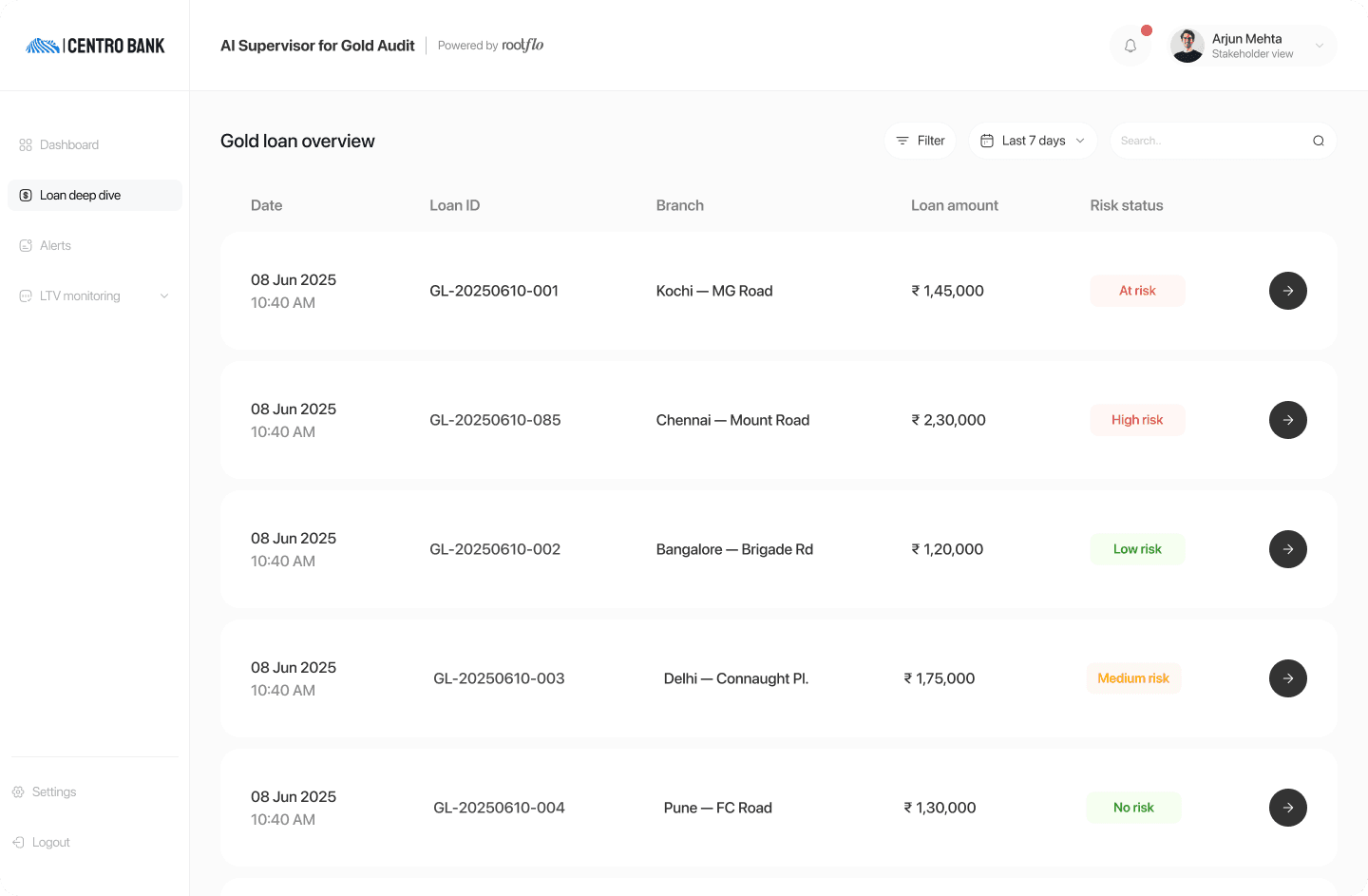
The Loan Deep Dive starts from a tabular loan overview with date, Loan ID, Branch & Zone, Loan amount and status.
Users can:
Filter by date range
Apply filters and sort through loans (risk, clarity, suspicious activity etc)
View risk status badges
Inside each loan details page, we get to view the AI image analysis results with metrics like:
Clarity Score
Overlap Score
Detected Items list
Stone-weight detection
Risks Identified
Suspicious Activities
prototype

Making the AI tangible for stakeholders.
Alongside the product experience, I built a functional prototype in Lovable to demonstrate how image analysis could work directly within a bank branch's own infrastructure. The prototype helped turn an abstract AI capability into something stakeholders could actually interact with.
01 / Upload
A branch agent uploads jewellery images.
02 / Analyse
The system runs the image through the AI evaluation pipeline.
03 / Understand
The results are returned as structured, actionable feedback.
The prototype helped us validate the workflow and communicate the potential of internal AI deployment more effectively than a conceptual presentation could.
*Initital prototype to match old UI style with Rootflo's embeds
Impact
Turning AI output into actionable audit signals.
The pilot demonstrated the potential to use AI as a supervisory layer in gold loan operations.
of high-risk applications correctly flagged for review.
reduction in variance in manual appraisal valuation.
More importantly, the product moved the AI from being a black-box prediction to something auditors could inspect, question, and act on.
What I learned
Design for the decision, not the data.
In an AI product, there can be an enormous amount of information available. The challenge is deciding what users actually need to make the next decision.
Explainability is an interaction problem.
Showing an AI score isn't enough. Users need to understand what happened, why it happened, and what they can do about it.
Keep humans in control.
For high-stakes workflows, AI should augment expertise rather than silently replace it.